How Much to Charge for Extra Revisions as a Freelancer
There’s no universal “right” price for an extra revision. There is a right way to work out yours. Here are two methods, worked examples, a revision policy line you can paste into proposals, and the email to send when round three shows up.
The short answer
Extra revision fee = hours a typical round takes you × your effective hourly rate, rounded up to a clean number, with a minimum charge for tiny rounds. Put the number of included rounds and the extra-round fee in your proposal before the project starts.
Need a change order form to bill it properly? Get the Scope Lock Kit for $29, instant download.
First, separate revisions from new work
Most revision fights are really definition fights. Settle this before you set a price:
- A revision refines the approved direction: tweak the color, tighten the copy, move a section, swap a photo.
- New work changes the direction or adds something: a fresh logo concept, an extra landing page, a new audience, a different video length.
Revisions use up rounds. New work gets its own quote as a change order, priced like any other project work. If you skip that line, a “revision” can turn into a redesign at the round price.
Also define what one round is. The simplest definition: one consolidated set of feedback, sent in one message. Five emails over two days with one change each count as one round only if you say so.
Method 1: Hourly estimate with a minimum
Best when revision size varies a lot, or you already bill hourly.
Formula: estimated hours × hourly rate, with a minimum charge (for example, one hour).
Worked example (illustrative numbers)
You bill $80/hour. The client wants a fourth round on a brochure. You estimate 2.5 hours.
2.5 × $80 = $200.
A week later they want a single word changed after final approval. That takes ten minutes, but your one-hour minimum applies: $80. The minimum isn’t greed. It covers reopening files, exporting, checking and re-sending, which takes the same time whether the change is one word or ten.
Downside: clients don’t love open-ended hourly numbers. If you go hourly, give an estimate and a cap: “about 2–3 hours, capped at $240.”
Method 2: Flat per-round fee from your effective rate
Best for fixed-price projects. Clients know the cost before they ask, which makes approval easy.
Step 1, find your effective hourly rate: project fee ÷ total hours the project actually took. Use a real past project, not a guess.
Step 2, find your typical round size: average hours per revision round on past projects. If you don’t track this yet, start logging it now. A scope-creep log does that job.
Step 3: per-round fee = typical round hours × effective rate, rounded up.
Worked example (illustrative numbers)
Your last logo project was $1,200 and took 16 hours in total, so your effective rate was $1,200 ÷ 16 = $75/hour.
Revision rounds on your recent logo projects averaged about 1.5 hours each.
1.5 × $75 = $112.50 → round up to $125 per extra round.
If your effective rate came out lower than you’d like, that’s useful too: it usually means unpaid extras already crept into past projects. Price extra rounds from the rate you want, not the one scope creep left you with.
Example extra revision fees by field (illustrative only)
These numbers aren’t market data or recommendations. They show how the per-round formula plays out with sample inputs. Plug in your own rate and round size.
| Field | What one round might be | Sample rate | Sample hours/round | Sample fee/round |
|---|---|---|---|---|
| Graphic design (logo) | One set of tweaks to the chosen concept | $75/hr | 1.5 | $125 |
| Web design (one page) | Layout and content changes on one page | $90/hr | 2 | $180 |
| Copywriting (sales page) | One consolidated round of edits | $70/hr | 1.5 | $105 → $110 |
| Video editing (2–3 min) | One list of timeline notes | $65/hr | 2.5 | $162.50 → $165 |
| Front-end development | One batch of UI change requests | $100/hr | 2 | $200 |
Illustrative examples to show the math. Your numbers will differ.
Free freelance revision policy template (one paragraph)
Paste this into your proposal or quote, above the signature or the “Approved” line. The best time to set an extra revision fee is before anyone needs one.
Each sentence does a job. It sets a number of rounds, defines a round, prices the extras, separates new work from revisions, and makes approval the trigger for extra work.
Bill extra rounds properly
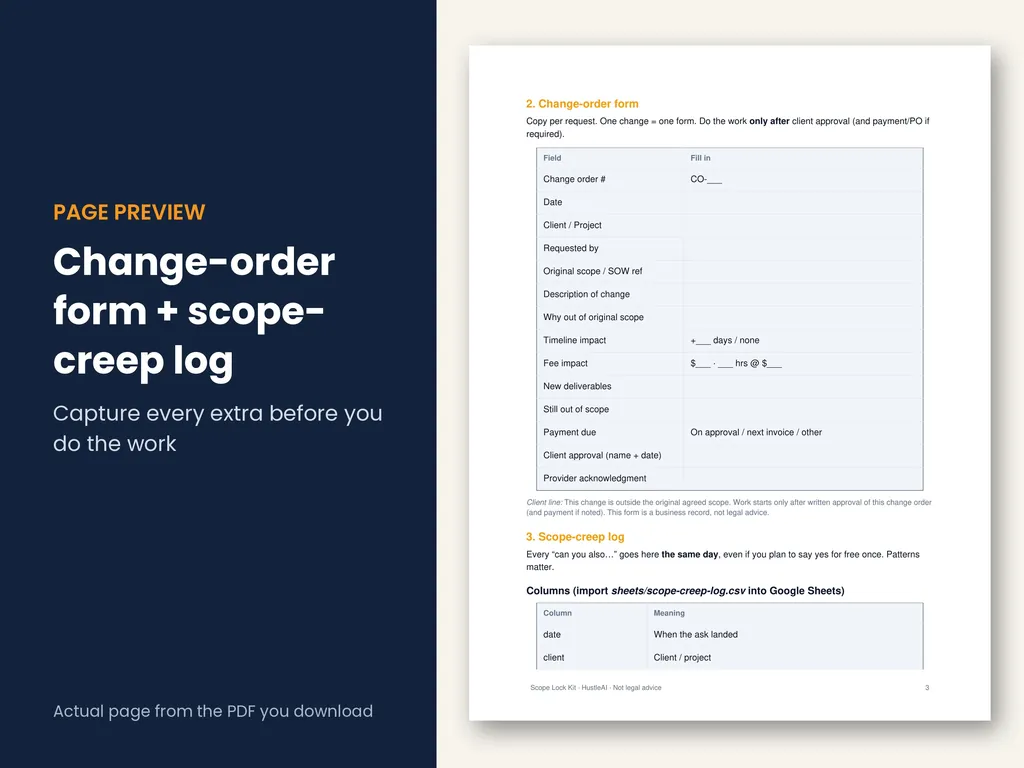
The Scope Lock Kit includes a change order form for each paid round, a scope-creep log to track rounds and hours, a kickoff checklist that locks the revision count in writing, and the out-of-scope email scripts.
Get the Scope Lock Kit — $29- Instant download after checkout
- 7-page PDF + 3 CSV templates
- Works in Google Sheets, Excel, Numbers
- Secure checkout by Stripe
Free script: when the client asks for round three
Send this before you start the extra round, not after. Reply in the same thread as the feedback.
Note the last line: asking for one consolidated list is the simplest way to stop round three from becoming rounds four, five and six.
How to charge for revisions in graphic design (and similar work)
- Show concepts deliberately. If you show three concepts, the client picks one before revisions start. Revising all three is new work.
- Lock direction in writing. Once a concept is approved, changing direction is a change order, not a revision.
- Count rounds out loud. “Here’s round 2 of 2” in your delivery email removes any surprise when round three costs extra.
- Log every round. Date, what changed, hours. After a few projects you’ll know your real round size, and Method 2 gets more accurate.
Pushback you’ll hear and how to answer
“Other designers include unlimited revisions.” Some do, and they price it into a higher fee or they rush. Your answer: “My price covers [2] focused rounds. That keeps the project moving and the cost predictable. Extra rounds are available at $[amount].”
“It’s just a small change.” Then the round is quick and the fee is small. Size doesn’t change the rule that it’s outside what was agreed. If you want to comp it, comp it on purpose and say so.
“We didn’t know there was a limit.” If it was in the proposal, point to it calmly. If it wasn’t, cover this round, then send the policy line for the rest of the project. Next time it goes in the kickoff checklist.
Related
When the request is bigger than a revision, a new page or a new concept, use the out of scope email template instead. It’s free in full, with a softer and a firmer variant.
FAQ
Should freelancers charge for revisions?
Charge for revisions beyond what you included in the quote. Most freelancers include a set number of rounds in the project price and bill extra rounds separately. The key is to state the number of included rounds and the extra-round price before the project starts, not when round four shows up.
How many revision rounds should I include?
Pick a number you can deliver profitably and write it down. Two or three rounds is a common choice for design and copy work, but the right number depends on how you price and how big each round usually is. Use your own past projects as the guide, and track rounds in a log so you know your real average.
What counts as a revision versus a new request?
A revision refines something within the approved direction: adjusting colors, wording, spacing or a section. A new request adds a deliverable or changes the approved direction, like a new logo concept, an extra page or a different target audience. Revisions use rounds. New requests get a change order with their own price.
Should I charge hourly or a flat fee for extra revisions?
Flat per-round fees are easier for clients to approve because they know the cost up front. Hourly works better when the size of the change is unpredictable. Many freelancers use a flat round fee for normal revisions and an hourly or quoted price for anything bigger.
How do I charge for revisions in graphic design?
State the included rounds in the proposal, define a round as one consolidated set of feedback, and set a per-round fee for extras based on your effective hourly rate and how long a typical round takes you. Treat new concepts or direction changes as change orders, not revisions.
What if the client won’t pay for an extra revision?
Point to the revision policy in the proposal they accepted, and offer choices: approve the extra round, combine all remaining feedback into one paid round, or accept the current version. If there was no written policy, consider covering this round and adding the policy for the rest of the project. This is general business guidance, not legal advice.
Back to Scope Lock Kit.